Is There a European People? Part 2
By Tyler D.
Part II — A people that can be built
Here we are at the second leg of our themed journey: the European People. In the prelude I broke the great objection—"there is no European people, nor can there ever be one"—into three questions. In Part I, I argued that a European people, blurred but real, already exists. Now I concede everything to my opponent: let us pretend I was wrong, that this people does not exist. The more interesting question remains: even if it did not exist, could it be built? My answer, here too, is yes—and not out of faith, but because it is exactly what every nation we now take for eternal actually did. As always: if you think I am deluding myself, write to me at the address below. We are Europeans; we do not fear the comparison.
Thesis
Did you know that the quintessential Thai dish, the one we eat in typical Thai restaurants—Pad Thai (which I love)—is a Chinese dish that the head of state of Siam (then Thailand) declared to be the national dish, in the early twentieth century, to forge a common culture for a non-existent people he wanted to build: the Thai people?
Peoples are not found ready-made in nature: they are made. They are the product of deliberate policies—school, language, infrastructure, military service, market, media, symbols—that within two or three generations turn a fragmented population into a nation with a shared consciousness. If this is true, then the objection "the European people is missing" loses its apparently decisive force: it is not a veto, it is a work programme. The very "toolkit" that made Frenchmen, Italians, and Germans is today largely available at European scale, and the Union—often without saying so—is already using several of its pieces. What is missing is not the possibility: it is the political will to complete the work.
1. The rule, not the exception: peoples are manufactured
Let us start with a phrase every Italian student knows: "Italy has been made; now we must make Italians." It is attributed to Massimo d'Azeglio, and it captures a deep truth; except that d'Azeglio, for the record, said something more bitter and more honest—"Unfortunately Italy has been made, but Italians are not being made."1 The point, beyond the anecdote, is that in 1861 the Italian state existed but Italians, as a people endowed with a common language and consciousness, largely did not. They had to be made. Today, barely 150 years later, we have parties that built their electoral consensus on the appeal to a supposedly lost Italian-ness. How things change. Italians were made, laboriously, with the school, conscription, the bureaucracy, and the national language imposed upon a mosaic of dialects—in a country where, at unification, the overwhelming majority spoke not Italian but their own regional vernacular.
This is not an Italian exception: it is the rule. Social science theorized it long ago. Karl Deutsch showed that nations form where the density of social communication grows—when roads, trade, literacy, and media bind together populations previously separate.2 Ernest Gellner, whom we met in the prelude, added that it is mass schooling that manufactures the shared "high culture" on which the modern nation rests; and Benedict Anderson that print in a common language creates the "imagined community."3 In all these models the people does not precede the state like bedrock: it is shaped, often by the state itself, with identifiable and repeatable tools.
The German case confirms the rule. Germany did not "exist" as a unified state before 1871: it was an infinite mosaic of kingdoms, principalities, and free cities, with distinct dialects and traditions. It was unified from above—by Bismarck's iron and blood, but also by the railway, the customs union (the Zollverein), and a Prussian school system taken as a model by the whole world. Just as France gave itself the Marseillaise and a national holiday, so every new nation built its own repertoire of anthems, monuments, and "traditions" that merely appeared ancient: that "invention of tradition" which Eric Hobsbawm showed to be typical precisely of the late nineteenth-century nationalist era.4 In every case—France, Italy, Germany—the script is the same: first the state, then, deliberately, the people.
Make no mistake: to say that peoples are constructed is not to belittle them, as if they were fictions to be unmasked. It is to recognize that belonging is a historical and voluntary fact—Renan's "daily plebiscite"—and not an immutable biological given. From this empirical evidence, however, follows a clear consequence: if peoples are made, then the European people too can be made. The question ceases to be metaphysical ("does it exist by nature?") and becomes political ("do we want to build it, and with what tools?"). It is the difference between suffering history and writing it—and no European generation has ever had, as ours does, the tools to write it on a continental scale.
If peoples are constructed, then the question "does a European people exist?" must be flanked by a different, more operational one: do we have the tools to build it? To answer, it is worth studying the case in which those tools were used in the most documented and most effective way: France.
2. The textbook case: how France "made Frenchmen"
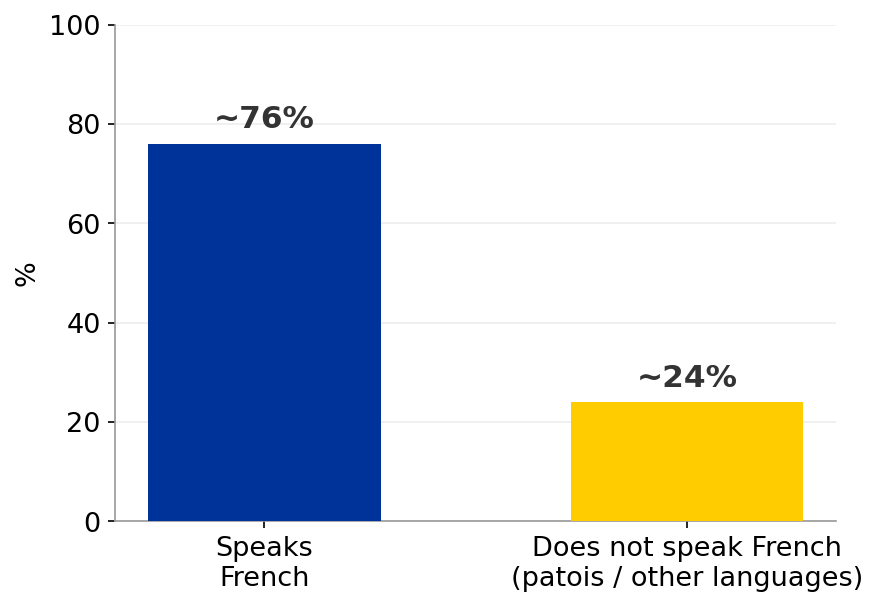
In 1863—one reads it in the classic work by the historian Eugen Weber, Peasants into Frenchmen—almost a quarter of the French population spoke no French at all—did not even understand it: millions expressed themselves in Breton, Basque, Alsatian German, Flemish, or one of the many regional patois.5 France, the nation that in the European imagination embodies the very idea of the compact nation-state, was barely a century and a half ago, linguistically and culturally, an archipelago. Not a people, but many peoples.
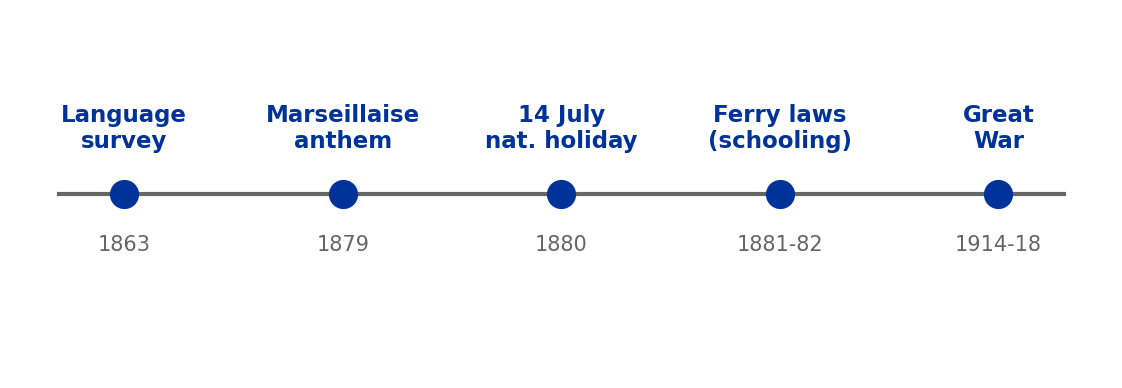
What transformed it? Weber shows it in abundant detail: in the two decades around 1900 the official national culture replaced the local one in the countryside, and it did so through a few powerful material tools.5 First, infrastructure: roads and above all railways tore remote regions out of isolation, connecting them to markets and the centres of modern life. Second, the school: with the Ferry laws of 1881-1882 primary education became free, compulsory, and secular, and the republican school taught everyone not only French but national values, patriotism, the geography and history of the fatherland.6 Third, military service: universal conscription mixed the young of every region in a single French-speaking institution, a "school of the nation" as much as the school itself.
To these were added the national market, which made economic interdependence an everyday experience; the mass press, which gave distant peasants the same facts and the same words; and an arsenal of symbols and rites deliberately built in those very years—the Marseillaise raised to national anthem (1879), 14 July established as national holiday (1880), the war memorials, the civic ceremonies. The speed is striking: the decades around 1900, less than two generations, sufficed for a population that mostly ignored the language of Paris to discover itself, and feel itself, "French."
It is worth dwelling on the school, because there the operation is visible to the naked eye. The republican schoolteacher, often sent far from his own region, had the explicit mandate to replace patois with French: in classrooms across half of France hung the sign "It is forbidden to spit on the ground and to speak Breton," and the child caught using the home language was punished. The mechanism, stripped of its brutality, is clear: give the same generation the same language, the same history, and the same maps, and in twenty years you will have a people ready to die in the trenches, where before there were many separate worlds.
Sealing the process came, tragically, the Great War: the trenches of 1914-18 definitively mixed men of every region in a common destiny, and the war memorials erected in every village became the secular altar of an identity by then shared. The nation that in 1863 was an archipelago of languages, half a century later mourned its dead as a single people. Nation-building and common sacrifice had fused—a foretaste, in passing, of the theme of Part III.
The decisive point, for us, is twofold. First: the French nation, which today appears a natural given, is largely a recent and deliberate construction. Second: it was not the work of a mere decree, but of the combination of material integration (roads, markets) and cultural integration (school, language, rites). Whoever says "a people cannot be created by law" is right and wrong at once: the law is not enough, but the law—accompanied by infrastructure, mobility, and education—works very well indeed.
3. The nation-building toolkit
From the French case, and from the parallel Italian and German ones, a genuine catalogue emerges of the tools with which a people is manufactured. It is worth listing them, because it is against this list that we will then measure Europe.
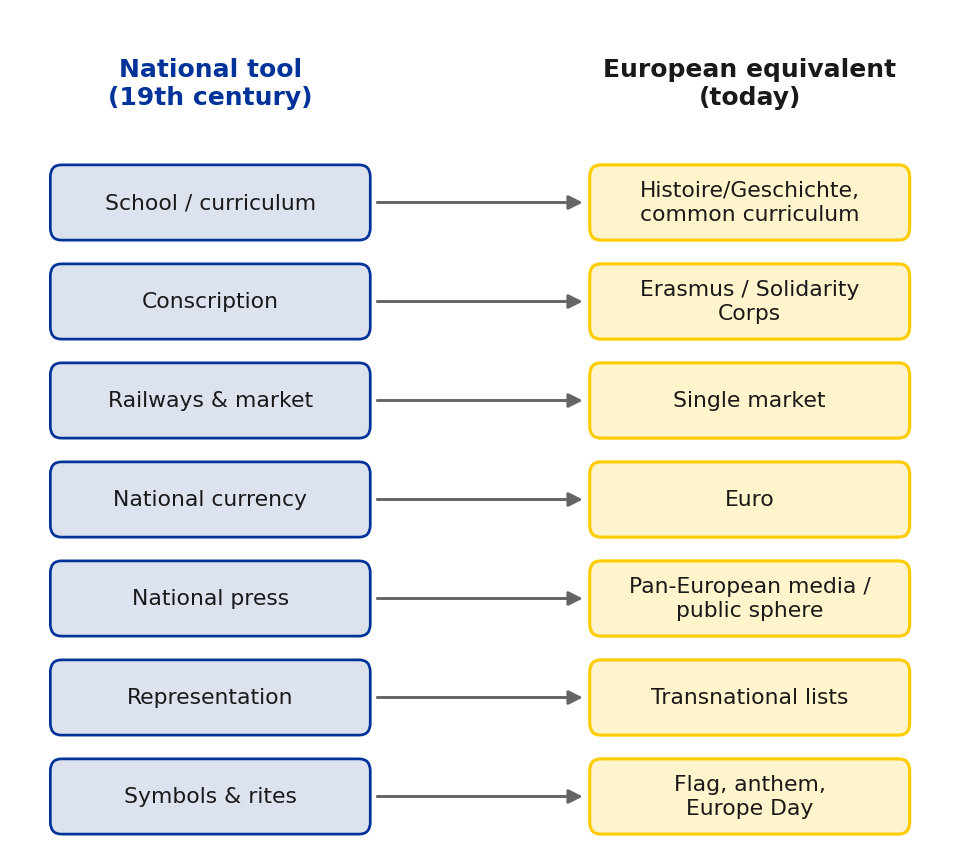
A common vehicular language, which does not necessarily erase the others but lets everyone communicate and recognize themselves in a single public space. A school with a shared curriculum, transmitting a common history and memory. An experience of mixing the young of every origin—once conscription, today ideally mobility. Infrastructure and an integrated market, which make interdependence a daily fact. A common currency, a powerful symbol as well as a tool. A shared public and media sphere, in which the same news is debated. A citizenship with equal rights, which makes belonging concrete. And finally symbols and rites—flag, anthem, holidays—that anchor identity to emotion and daily repetition: what the sociologist Michael Billig called "banal nationalism," the flag waving unnoticed on the public building and, for that very reason, shaping belonging.7
Keeping this list before our eyes, let us pose the question that counts: how many of these tools are, today, within Europe's reach?
4. Europe can do it—and in part is already doing it
The answer is surprising, because the Union already possesses most of those tools, or is quietly activating them. One need only reread the same list with European eyes.
The currency: the euro is in the pockets of over 340 million people, one of the most powerful factors of shared identity ever created institutionally—think how much the lira or the mark were part of national identity, and how much common banknotes, free of portraits of kings and warlords and adorned with bridges and windows that unite, are an identity manifesto more than a mere means of payment. Just in these very weeks, the whole European people is being called to choose the design of the next banknotes. The market: the single market has made economic interdependence a daily fact from Lisbon to Tallinn, weaving among Europeans that dense web of exchange which Deutsch identified as the true loom of nations. Citizenship: Union citizenship, with the freedom to move, reside, and work anywhere, has made European belonging a concrete right and not an abstraction—tens of millions of Europeans today live, love, and work in a Union country other than the one of their birth. The vehicular language: as I showed in Part I, English now performs, in practice, the function that standard French performed for France—with the not-small difference that no one imposes it. The mixing of the young: Erasmus is our gentle conscription, fifteen million Europeans mixed across borders since 1987, and growing.8 The symbols: the twelve-star flag, the anthem (the Ode to Joy), Europe Day on 9 May already exist; and a Billig-style "banal Europeanism" can be breathed in Eurovision, in the European football championships, in the signs marking a project funded by the EU.
What is missing, then? What is missing are above all the properly political tools of building a people, those that turn a lived belonging into a community that decides. But note: even here we do not start from zero, because of each of the missing pieces at least one prototype already exists.
Missing is a school with a common core of European history—and yet the precedent exists: in 2006 France and Germany published Histoire/Geschichte, the first secondary-school history textbook written jointly by two countries, with a shared reading of the European past.9 If two nations that had fought each other for a century managed to write their history together, a European curricular core is no utopia: it is an already-tested project, to be extended. Missing is a genuine civic mixing beyond university students—and yet the European Solidarity Corps has offered, since 2017, thousands of young people an experience of volunteering and service in another Union country: the embryo of that European civic service which could do, for this generation, what conscription did for the French.10 Missing is a completed public sphere—and yet there are seeds such as Arte or Euronews, media with a pan-European vocation, still far from a true continental public sphere but not non-existent.
Missing, finally and above all, is a representation that Europeanizes politics: transnational lists, that is, a pan-European constituency in which citizens vote for candidates from across the continent. The European Parliament has repeatedly proposed them—even reserving a share of seats for a single Union-wide constituency—but the reform remains stuck in the Council and was not adopted for the 2024 elections.11 Yet the logic of that proposal is precisely ours: to create a common constituency "to foster a pan-European campaign and to contribute to building a European sphere of debate."11
Among the missing pieces, the two properly political ones—the public sphere and transnational representation—are the keystone. Without them Europe remains what it is today: a people that already lives together—travels, trades, studies, uses the same currency—but that does not deliberate together, that has no common place in which to argue democratically about its shared choices. It is like a France with railways and a market but without suffrage: a body without its political voice. To give that body a voice—this, more than anything else, is the task of our generation.
The operational conclusion is clear: to build the European people does not require inventing new, unknown tools, but completing and making political those we already have. A common history curriculum on the model of Histoire/Geschichte, pan-European media, a European civic service extending the Solidarity Corps, transnational lists that Europeanize the vote. It is no utopia: it is ordinary nation-building, applied a century and a half late on a larger scale.
In practice: five moves
If the European people can be built, it is worth saying with what concrete moves. I propose five, all within reach of a political decision and free of any coercion:
- A common core of European history in the continent's schools, on the model of Histoire/Geschichte, to give the new generations a shared narrative alongside—not instead of—the national one.
- A universal Erasmus and a European civic service, extending the Solidarity Corps, so that mobility ceases to be a privilege of university students and becomes a mass experience: the "gentle conscription" that mixes twenty-year-olds as the draft once did.
- A European public sphere, by supporting genuinely pan-European media and common digital infrastructure, so that Europeans debate the same issues at the same moment and in the same vehicular language.
- Transnational lists for European elections, so that a share of deputies answers to a continental electorate and politics ceases to be the mere sum of twenty-seven national campaigns.
- A denser European citizenship, with political and social rights genuinely enforceable everywhere, so that belonging is measured in concrete prerogatives and not only in symbols.
None of these moves asks to do violence to national identities; each adds a European layer to what already exists. They are, to resume the image, so many stretches of railway and so many classrooms of our belated nineteenth century.
5. Objections and rebuttals
First objection: "Nineteenth-century nation-building was coercive and even violent: the French school humiliated the patois, repressed regional languages. Do you perhaps want to erase Europe's national cultures?" No, and this is the decisive difference. The model I described contains a historical error we must not repeat: forced assimilation, the single language imposed at the expense of others. But that error is not essential to nation-building; it is a defect of its era. The construction of the European people rests on the opposite principle, "unity in diversity": a vehicular language that is added to the national languages without replacing them, a continental identity that is added to local ones like a wider circle—exactly the stratification, not the substitution, that I documented in Part I. To make Europeans does not mean to unmake the French or the Italians. It means adding a floor, not demolishing one.
Second objection: "But then it is all artificial, engineered at a desk: a manufactured identity is not authentic." This objection, if taken seriously, proves too much: because all national identities are constructed, "invented" in Hobsbawm's sense—from 14 July to the history textbooks. If artificiality disqualified a people, then no legitimate peoples would exist, and today's Frenchman or Italian would be a phantom. The authenticity of an identity does not depend on its spontaneous origin—none is spontaneous—but on the fact that people live it as their own and choose it. What makes the construction legitimate is not its "naturalness," which does not exist, but the democratic consent of those who take part in it.
Third objection: "Identity cannot be decreed from above; these top-down projects fail." It is a serious objection, and Weber himself is its best answer: France did not "decree" Frenchmen with a signature, it built them over decades by combining institutions and material integration, school and railways, law and daily life. Purely top-down nation-building, without rootedness in lived experience, does indeed fail. But this is precisely the strength of the European position: bottom-up integration has already happened—Erasmus, the euro, mobility, the common youth culture of Part I—and only awaits completion from above with the missing political tools. We do not start from zero; we start from a half-made people.
Fourth objection: "France needed a century and a strong, coercive state. The Union has neither." True, the Union lacks the nineteenth-century centralizing state; but it has tools unknown to that state and faster-acting: mass mobility, digital media, a lingua franca that spreads by itself, a continental market and currency. France took fifty years to bring French into every valley on foot and by train; English and digital platforms cross Europe in real time. The paradox is that Europe can build its people without the coercion the French case required—by consent and not by imposition. It is a nation-building slower in politics, but faster and gentler in society.
Fifth objection: "But Europe's linguistic diversity is incomparably greater than that of French regions: twenty-four official languages are not the patois of Brittany." The objection grasps a real difference, but not an insurmountable obstacle. There exist perfectly functioning multilingual federations: Switzerland with four official languages, Canada, India with dozens of tongues. In them political unity did not require linguistic unity, but a shared language of communication alongside multilingualism—exactly the role English plays in Europe today, further boosted by machine-translation technologies no nineteenth-century state could dream of. Europe's linguistic diversity is not to be abolished—that would betray the very principle of "unity in diversity"—it is to be made navigable. It is a problem of bridges, not of demolitions.
6. Conclusion of Part II
I return to the opening question. Even granting—for the sake of argument—that a European people does not exist today, could it be built? The answer is yes, and with nothing mysterious about it: with the same tools by which all the peoples we now consider self-evident were built. France proves it: an archipelago of languages and cultures became a nation in two generations, thanks to school, language, mobility, market, symbols. Europe already possesses much of that toolkit—currency, market, citizenship, mobility, lingua franca, symbols—and lacks above all the political pieces: a common historical narrative, a completed public sphere, transnational representation. These are gaps fillable by deliberate choices, and moreover without the brutality that marked the nineteenth century. In the end the stakes are not technical but a matter of will: the tools are there; what is missing is the decision to use them for what they truly are—bricks of a people.
There remains one last, decisive question. So far I have spoken of voluntary construction, of targeted policies. But history teaches that peoples also weld together in another way, older and more powerful than any school law: by drawing close in the face of a common threat. Is it possible that the European people, rather than being built at a desk, is already forming by itself under the pressure of the great powers? To this—to the external enemy as the involuntary blacksmith of unity—is devoted Part III.
Until next time, and thank you for making it this far.
Tyler.
Notes
- The popular phrase "Italy has been made; now we must make Italians" is traditionally attributed to Massimo d'Azeglio; his documented words were in fact more pessimistic: "Unfortunately Italy has been made, but Italians are not being made" (I miei ricordi). Cf. S. Patriarca, "On the Origins of 'Making Italy': Massimo d'Azeglio and 'Fatta l'Italia, bisogna fare gli Italiani'," 2010. ↩
- K. W. Deutsch, Nationalism and Social Communication: An Inquiry into the Foundations of Nationality, MIT Press, 1953. Nations form as the density of communication and exchange among populations increases. ↩
- E. Gellner, Nations and Nationalism (1983); B. Anderson, Imagined Communities (1983). Mass schooling and print capitalism as the factories, respectively, of national "high culture" and of the "imagined community." (Cf. Part I.) ↩
- E. J. Hobsbawm, T. Ranger (eds.), The Invention of Tradition (1983). Many "national" rites and symbols perceived as ancient (holidays, anthems, ceremonies) were constructed in the late nineteenth century. ↩
- E. Weber, Peasants into Frenchmen: The Modernization of Rural France, 1870-1914, Stanford University Press, 1976. In 1863 almost a quarter of the French population spoke no French; national culture replaced the local one in the two decades around 1900, through roads and railways, school and military service. https://archive.org/details/peasantsintofren0000webe ↩
- Ferry laws: the law of 16 June 1881 made primary education free; that of 28 March 1882 made it compulsory (ages 6-13) and secular, founding the republican school. https://en.wikipedia.org/wiki/Jules_Ferry_laws ↩
- M. Billig, Banal Nationalism, Sage, 1995. National identity is reproduced daily by "unnoticed" symbols (the flag on the public building, recurring rites). ↩
- European Commission, Erasmus+ — History, funding and future: over 15 million participants since 1987. https://erasmus-plus.ec.europa.eu/about-erasmus/history-funding-and-future ↩
- Histoire/Geschichte (2006): the first secondary-school history textbook written jointly by two countries (France and Germany), with a shared reading of European history. https://en.wikipedia.org/wiki/Histoire/Geschichte ↩
- European Commission, European Solidarity Corps, an EU programme active since 2017 for young people's volunteering and service in another Union country. https://commission.europa.eu/funding-and-tenders/find-funding/eu-funding-programmes/european-solidarity-corps_en ↩
- European Parliament, proposal to reform the EU electoral law (2022) with a pan-European constituency and a reserve of 28 seats for transnational lists; the reform remained stuck in the Council and was not adopted for the 2024 elections. Stated aim: "to foster a pan-European campaign and to contribute to building a European sphere of debate." https://www.europarl.europa.eu/news/en/press-room/20220429IPR28242/meps-begin-revising-rules-on-eu-elections-calling-for-pan-european-constituency ↩
Select bibliography
- Anderson, Benedict, Imagined Communities: Reflections on the Origin and Spread of Nationalism, 1983.
- Billig, Michael, Banal Nationalism, Sage, 1995.
- Deutsch, Karl W., Nationalism and Social Communication, MIT Press, 1953.
- Gellner, Ernest, Nations and Nationalism, 1983.
- Hobsbawm, Eric J. and Ranger, Terence (eds.), The Invention of Tradition, 1983.
- Patriarca, Silvana, "On the Origins of 'Making Italy': Massimo d'Azeglio and 'Fatta l'Italia, bisogna fare gli Italiani'," 2010.
- Weber, Eugen, Peasants into Frenchmen: The Modernization of Rural France, 1870-1914, 1976. https://archive.org/details/peasantsintofren0000webe
- Histoire/Geschichte, Franco-German history textbook, 2006. https://en.wikipedia.org/wiki/Histoire/Geschichte
- European Commission, European Solidarity Corps. https://commission.europa.eu/funding-and-tenders/find-funding/eu-funding-programmes/european-solidarity-corps_en
- European Parliament, transnational lists / pan-European constituency, 2022. https://www.europarl.europa.eu/news/en/press-room/20220429IPR28242/meps-begin-revising-rules-on-eu-elections-calling-for-pan-european-constituency
- European Commission, Erasmus+ — History, funding and future. https://erasmus-plus.ec.europa.eu/about-erasmus/history-funding-and-future