Is There a European People? Part 3
By Tyler D.
Part III — A people that is forming
The last leg of our journey, perhaps the most obvious, but not for that the least important. In the prelude I broke the great objection—"there is no European people, nor can there ever be one"—into three questions. In Part I, I argued that a European people, blurred but real, already exists. In Part II, that even if it did not, it could be built, as Frenchmen and Italians were built. There remains the third answer, the most unsettling and perhaps the most powerful: that the European people is forming right now, before our eyes, not because someone is constructing it at a desk, but because something is welding it from outside. That something is the pressure of the great powers. As always: if you think I am reading reality crookedly, write to me at the address below!
Thesis
Peoples are welded not only by the school and the currency: they are welded, and faster, in the face of a common threat. It is one of the oldest and best-documented truths of social life: when a group feels threatened from outside, its internal cohesion rises exponentially, divisions recede, leadership strengthens. The thesis of this Part III is that Europe is undergoing exactly this process. The transition to a multipolar world—with Russia attacking at the borders, the United States revealing itself clearly for its true role, not that of an ally but of a dominus, and China asserting itself as a systemic rival—is acting as the involuntary blacksmith of European unity: it is producing, shock after shock, the common consciousness that decades of proclamations had failed to generate. The external enemy—or more precisely the condition of shared exposure—is doing for the European people what the republican schoolteacher did for the French, only faster.
1. The involuntary blacksmith: why threat unites
Let us start with the theory, because the phenomenon is not a rally-speech intuition but an established result of social science. Georg Simmel first and Lewis Coser later formulated it precisely: conflict with an outside group increases the internal cohesion and centralization of the threatened group; members close ranks against the common enemy. Coser went so far as to observe that groups may even seek enemies for the purpose—conscious or unconscious—of maintaining their unity, and that even an imaginary threat performs the same integrating function as a real one.1 It is the mechanism American political scientists call the rally round the flag effect: in the face of external danger, factions draw together. Well known, used and abused by the American elite throughout the twentieth century and, even more, in these years—from the war on terror to Trump's recent adventures, may we call them that, in Iran.
International relations theory says something analogous at the level of states. Stephen Walt refined the old "balance of power" into a "balance of threat": states do not ally against whoever is merely more powerful, but against whoever they perceive as more threatening—where threat depends on aggregate power, geographic proximity, offensive capabilities, and offensive intentions.2 It follows that a threat that is near, aggressive, and hostile in intent pushes exposed states to coalesce. Not by chance have some scholars reread the whole of European integration as a balance-of-threat phenomenon: Europe has united, every time, under the spur of a danger. A danger, in truth, that is also endogenous.
There is more. Karl Deutsch—the scholar we met in Part II—studying how "security communities" arise, those areas in which war among the members becomes unthinkable, showed that they form when the density of transactions and the perception of a common destiny cross a certain threshold. The external threat accelerates both: it multiplies exchanges—military, diplomatic, financial—and imposes the perception, brutal but clarifying, of a shared destiny. Danger, in other words, does not merely close ranks out of fear: it builds, as a by-product, the relational infrastructure from which a stable community is born. That is why unity born under threat, if well channelled, can last well beyond the threat itself.
Following this path we run into an uncomfortable intellectual: that the political community is defined also through the "friend/enemy" distinction is the famous thesis of Carl Schmitt—an author whose Nazi political sympathies are well known and documented. But I am not the kind of commentator who cannot see the reflection beyond the man's choices, nor will I ever be a perpetrator of cancel culture. I cite Carl Schmitt for the analysis, of course, not for the person's ethics.3 The idea that the "we" takes shape against a "they" captures something real. We will return to it among the objections. For now let it suffice to register the mechanism: the external threat is a powerful political glue. The question—rhetorical, I believe—is whether it is acting, today, upon Europe.
2. The lesson of history
Before the present, the past. History is a long sequence of peoples who discovered themselves to be such in the face of an invader.
The archetypal case is that of the Greeks. The poleis—Athens, Sparta, Corinth, Thebes—were jealous rivals, often at war with one another, incapable of stable unity. And yet, faced with Xerxes' Persian invasion in 480 BC, they coalesced in the Hellenic League and repelled the largest empire then known.4 It was the common threat, not an abstract ideal of pan-Hellenic unity, that produced cooperation. When the Persian danger receded, the Greeks went back to dividing, but at the decisive moment the existence of a Hellenic "we" against a barbarian "they" had shown itself with force.
An even more pertinent case, because it flowed into a federal state, is that of the thirteen American colonies. Yes, the very global hegemon is born from a path of this kind—or does someone believe that Virginia or Massachusetts would have dominated the globe on their own? They were separate entities, distrustful of one another, with distinct economies, churches, and identities: a Virginian and a Massachusetts man had, at first, little in common. What turned them into a people was not primarily an enlightened project, but the hostile pressure of the British mother country: taxation without representation, coercion, war. Against that common enemy the colonies allied, confederated, and finally, when the fragile confederation proved too weak to hold up against the powers of the world, gave themselves a federal constitution. The "Americans" as a people were, in no small measure, a product of the struggle against London: first came the threat and the war, then—not before—the nation.
Europe, in fact, has already experienced this powerful mechanism once. The first post-war European integration—the Coal and Steel Community, then the Economic Community—was born in the shadow of a twofold pressure: the Soviet threat to the East and the need to anchor Germany to a common order so that it would not again threaten its neighbours. The founding fathers, from Schuman to De Gasperi, were not disarmed dreamers: they were realists who had seen two world wars and knew that only integration could make war between Europeans "not only unthinkable, but materially impossible." It was, then too, a unity partly defensive, matured under the American umbrella and the spur of Soviet fear. Europe knows how to unite under threat: it has done so before, and it is how the Union itself was born. What is new today is that the threat has returned—from several directions at once—just as the umbrella that once softened it begins to close.
3. The shocks that are welding us
Now to the present, which is the heart of the argument. In recent years Europe has passed through a rapid sequence of external shocks, and to each it has responded with a leap of integration that, in normal times, would have been judged unthinkable.
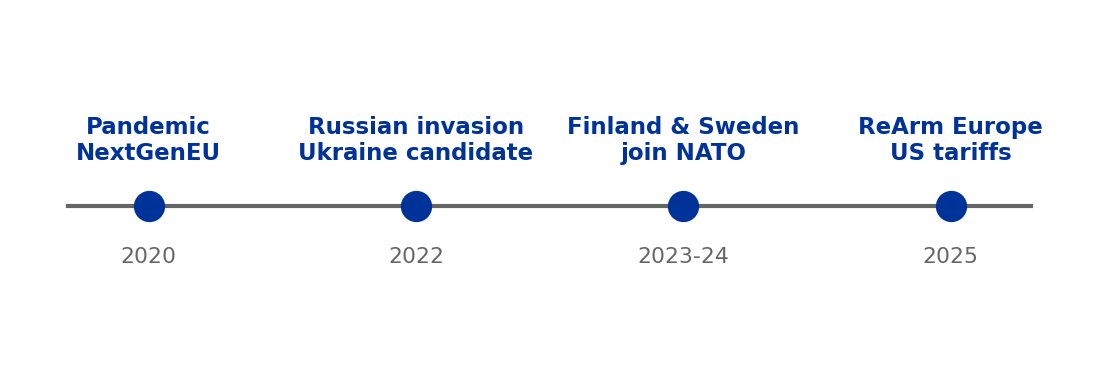
2020 — the pandemic. Faced with a symmetric, global shock, the member states broke a historic taboo: for the first time they borrowed in common. NextGenerationEU, over 800 billion euros raised jointly on the markets, was an act of fiscal solidarity that the austerity of the sovereign-debt crisis had made, only a few years earlier, simply inconceivable.5 It was the first, timid European "Hamiltonian moment," and it came under the lash of an external emergency.
2022 — Russian expansionism. Here the shock was geopolitical and brutal, and the response accordingly. The Union adopted unprecedented packages of sanctions—seventeen and more—against Russia;6 it used the European Peace Facility for the first time to finance arms supplies to a non-EU country, Ukraine, going so far as to allocate billions;7 and it granted Ukraine itself candidate-country status, by unanimity of the twenty-seven.8 On the security front, two historically neutral countries, Finland and Sweden, abandoned decades of non-alignment to join NATO.9 Germany proclaimed its Zeitenwende, the "epochal turn," allocating a special fund of a hundred billion for its armed forces and overturning a doctrine of military prudence eighty years old. The Union launched RePowerEU to free itself from Russian gas (with debatable results, but we'll come to that), created a joint gas-purchasing platform, and opened accession negotiations with Ukraine and Moldova. In a few months, taboos that seemed eternal—enlargement in wartime, common energy purchasing, weapons financed from the common budget, Nordic neutrality—fell one after another. No treaty negotiated in cold blood had ever produced as much integration as a single year of war at the borders.
2025 — the ally who drifts away (or shows itself for what it has always been). The pressure does not come only from the East. The return of an interventionist US administration—tariffs on the Union, explicit doubts about the security guarantee, the demand to pick a side in the competition with Beijing, war in Iran—pushed Europe to do what it had avoided for seventy years: to think about its own defence by itself. In March 2025 the Commission launched the ReArm Europe / Readiness 2030 plan, which aims to mobilize up to 800 billion euros for European defence (still too little, but we'll come to that): about 650 billion freed by suspending the budget rules for military spending, plus a new common loan instrument of 150 billion, SAFE.10 Germany itself did the unthinkable, reforming its constitutional "debt brake" to be able to spend on defence—a dogma of fiscal rigour that seemed untouchable, sacrificed to the necessity of the moment. A continent that rearms together because it can no longer count on someone else's umbrella is, literally, a people discovering it must look after itself, and discovering, in doing so, that it is a "we."
In the background, permanent, there is China: not a military aggression, but a systemic challenge—technological, commercial, industrial—that the Union has learned to call de-risking. Chinese dominance over rare earths and clean technologies, the wave of subsidized electric vehicles, dependence on supply chains controlled by Beijing: these are pressures that push Europeans to coordinate industrial policy, tariffs, and economic security as a single bloc, because no member state, alone, has the heft to negotiate on equal terms with a continental colossus. Three different pressures—Russian, American, Chinese—thus converge on the same effect: they force Europeans to ask who they are, and to answer, more and more often, "Europeans."
The thread linking these episodes is clear. In every case the sequence is identical: an external shock makes a common exposure plain; the exposure demands a response no state can give alone; the common response creates or strengthens a European institution; the institution, in turn, accustoms citizens to thinking of themselves as part of a single body politic. Pandemic, war, energy blackmail, an ally slipping away: the triggers change, not the mechanism. And above all the speed changes. The integration that treaties negotiated in cold blood had struggled to produce in decades, the shocks have produced in months. The history of the Union, on close inspection, is not that of a plan advancing in a straight line, but of a series of leaps forward under pressure, separated by long lulls. We live, today, in a season of leaps.
4. The mirror of public opinion
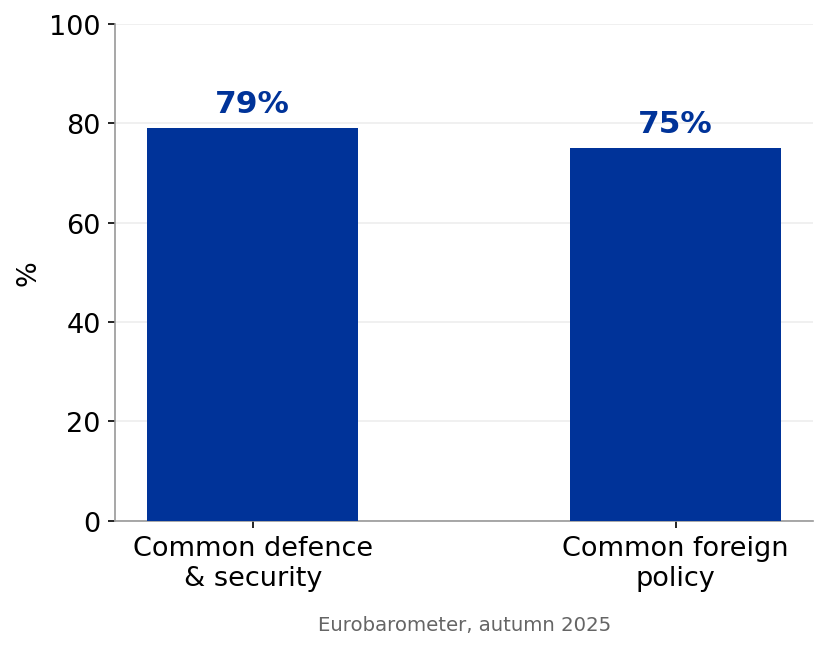
That all this does not stay confined to the summits is told by the polls, the mirror in which threat-driven cohesion becomes measurable. According to the autumn 2025 Eurobarometer, 79% of citizens are in favour of a common defence and security policy—the second-highest figure since 2004—and about 75% of a common foreign policy.11 These are not avant-garde-movement numbers: they are broad and rising majorities, risen precisely in the wake of the shocks.
Even more revealing are the surveys of the European Council on Foreign Relations (ECFR): after 2022, and still more after 2025, Europeans declare themselves ready to defend themselves, regard the United States no longer as an "ally" but as a "necessary partner" with which to cooperate out of calculation, and support an increase in military spending.12 It is the portrait of a public opinion that is internalizing, in real time, the realist lesson: if the world grows dangerous and the protectors grow unreliable, one must rely on oneself, and that "self," for a European state too small, can only be Europe.
Two details make the picture more significant still. The first: trust in the Union, in the same Eurobarometer, has reached its highest level in almost twenty years—a sign that threat-driven cohesion is not only support for a policy, but a strengthening of the bond with the common institution. The second, which takes us back to Part I: Europeanism is stronger among the young, the Erasmus generation of nested identities. External pressure, in other words, acts on already fertile ground: it does not have to create the European people from nothing, but to awaken and accelerate one that was already forming. Threat and substrate work in the same direction.
It is worth stressing the stakes of that institutional "sediment," because it is what distinguishes European unity from the ephemeral unity of the Greeks. Every shock has left behind a structure meant to last: the euro after the monetary crises of the twentieth century, the common debt of NextGenEU after the pandemic, the European Peace Facility and the defence capabilities after 2022, the joint energy purchases after the gas blackmail. These are bricks no one will dismantle when the tension subsides, because by then they will have become part of the ordinary skeleton of the Union. Fear passes, the institutions it builds remain.
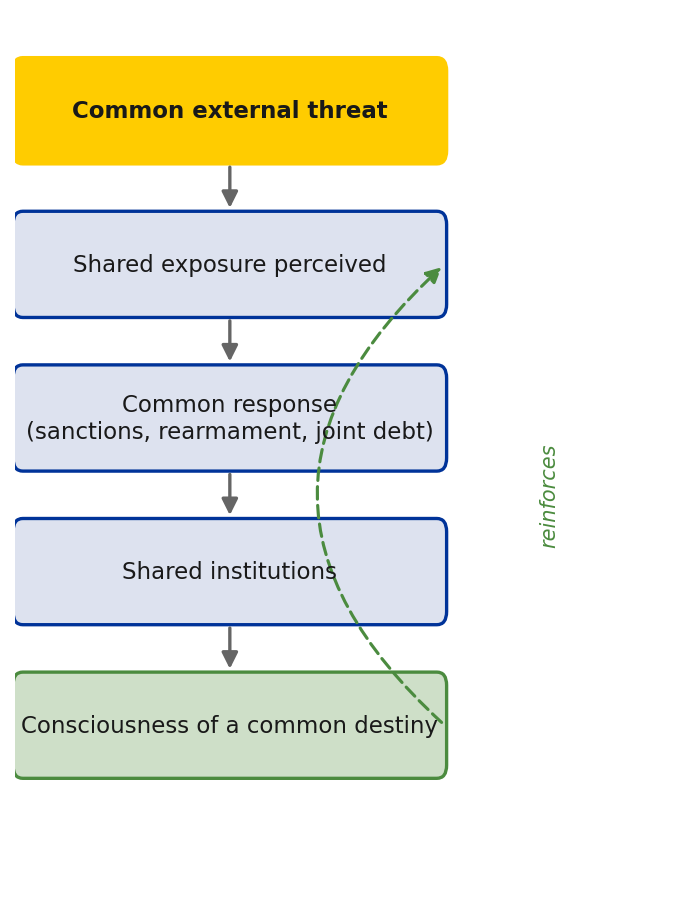
The mechanism, then, can be summed up in a chain: common external threat → shared perception of danger → common response (sanctions, rearmament, joint debt, enlargement) → shared institutions and habits → consciousness of a common destiny. The same circuit Simmel and Coser described for small groups, projected onto the scale of a continent. Every turn of the circuit leaves an institutional sediment—a common fund, an agency, a military capability—that does not evaporate when the tension falls. The threat lights the fire; the institutions build the hearth that holds it.
5. Objections and rebuttals
First objection: "Threat divides as much as it unites. Not all Europeans jump the same way: some governments flirt with Moscow, others court Washington." True, and the theory predicts it. Walt observes that, while exposed states tend to coalesce against the threat, the weaker or more exposed (or the less far-sighted, I would add) may also "bandwagon" with the stronger.13 Defections exist and must be taken seriously. Two observations on this:
First: the aggregate trend is unequivocal—sanctions approved unanimously, Ukraine's candidacy voted by all twenty-seven, common defence supported by 79% of citizens. The exceptions are noise around a strong signal—and they are, often, exceptions in word more than in deed: even the most lukewarm governments ended up voting the sanctions and the Ukrainian candidacy, because the cost of staying outside the European "we," at the moment of danger, appeared higher than the price of joining it.
Second: the very fact that some "bandwagon" with the threatening power proves that the threat is real and is forcing choices of side—exactly what welds the others. The bandwagoning of a few is the proof, not the refutation, of the pressure.
Second objection: "Unity born of fear is superficial and temporary: it will vanish as soon as the threat recedes, like the Greeks after the Persians." The objection is serious and partly well-founded: purely reactive cohesion can sag. But it overlooks two facts. First: the present shocks are not an isolated episode, but the manifestation of a structural transition destined to last decades, not seasons. Second, and decisive: unlike the Greeks, Europe institutionalizes. Every shock leaves behind a permanent structure, the common currency, the common debt, the defence capabilities under construction, that survives its own trigger. Precisely here the three Parts of this series come together: the threat (Part III) accelerates a people that already exists (Part I) and that we can deliberately consolidate (Part II). Fear ignites; the shared civilization and the institutions hold.
Third objection: "Building a people against an enemy is dangerous and illiberal: it is Schmitt's logic, which leads to militarism and xenophobia." True, in part I agree. An identity founded solely on hostility toward a "they" is toxic: it breeds aggressive nationalism, scapegoats, a climate of hatred. But here is the decisive distinction. The European "we" I am describing does not define itself against a people—not against Russians, Chinese, or Americans as persons—but against a condition: subordination, the loss of self-determination, being an object and not a subject of history. The threat is the spark that lights the fire, not the brick the house is made of. The substance of the European people remains that of Parts I and II: a shared civilization and a democratic project. A unity that is born to defend freedom and values—and not to attack—is not Schmittian: it is the oldest and most legitimate of reasons to stand together. There is more: precisely because Europe safeguards, as I argued in the previous Parts, a model of civilization founded on humanism and the dignity of the person, its "we" has a very strong internal antidote against any drift. A European people that betrayed its humanistic vocation to become a resentful fortress would cease, in that gesture, to be what it claims to want to defend. The threat gives us the push to unite; it is the values that tell us how to do it without disfiguring ourselves.
Fourth objection: "Then you wish for wars and crises, because they suit you: this is cynicism." Granted that no one wishes for anything and that here we are analysing what is happening. No, and it is a moral difference, not only a logical one. To recognize that threat unites does not mean to desire it, just as the physician who studies epidemics does not wish for them. The threat is there, whether we like it or not; the only choice left to us is whether to suffer it in fragmentation or face it in unity. To waste a crisis by letting it find us divided is the real fault. To transform pressure into agency, to "prepare instead of improvise," to use the words of our own manifesto, is not cynicism: it is responsibility.
6. Conclusion — and the close of the trilogy
We have reached the end, and the three threads can finally be tied. We asked: is there a European people, nor can there ever be one? Well, we answered three times yes. Yes, a European people already exists, blurred but real, rooted in a shared civilization and in a belonging the numbers record (Part I). Yes, that people can be built deliberately, with the same tools that made the French and the Italians, and without their brutality (Part II). And yes, that people is forming now, welded by the pressure of the great powers like iron under the blacksmith's hammer (Part III). The three answers do not exclude one another: they add up. A people that is already there, that we can help to grow, and that history is forging for us.
One thing remains, the most important, and it depends neither on historians nor on pollsters: it depends on us. The threat offers the occasion, not the guarantee. It can weld us into a sovereign European state, capable of defending our freedom and our values; or it can find us divided, and then it will overwhelm us one by one. The window will not stay open forever: historical opportunities are rare and fleeting, and the same pressure that welds us today could tomorrow, if it found us unprepared and fragmented, simply carve us up. The difference between the two fates will not be decided by the great powers: it will be decided by us, by the choice to turn fear into a project. The blacksmith is striking the iron. It is up to us to decide whether to become a sword or to remain shards scattered on the anvil.
With this our little trilogy on the European people comes to a close. Thank you for reading this far: whether you agree or are furious, it is already, in its way, a small piece of European public sphere. If you have a topic you would like to see treated by this wretched commentator, write to me! See you soon.
Tyler.
Notes
- L. A. Coser, The Functions of Social Conflict, The Free Press, 1956, systematizing insights of Georg Simmel: conflict with an out-group increases the cohesion and centralization of the in-group; groups may seek enemies to maintain unity, and even an imaginary threat performs an integrating function. ↩
- S. M. Walt, The Origins of Alliances, Cornell University Press, 1987. The "balance of threat" theory: states ally against the perceived threat (a function of aggregate power, proximity, offensive capabilities and intentions). On reading European integration as a balance-of-threat phenomenon see also E-International Relations, "Integrating under Threat" (2021). https://en.wikipedia.org/wiki/Balance_of_threat ↩
- C. Schmitt, The Concept of the Political (1932): the "political" is constituted around the friend/enemy distinction. Schmitt's Nazi sympathies are well documented; the reference is purely analytical and implies no endorsement. ↩
- Herodotus, Histories, books VII-IX: the Hellenic League against Xerxes' Persian invasion (480 BC). The unity of the Greeks was produced by the common threat and loosened once it receded. ↩
- NextGenerationEU: a post-pandemic recovery instrument of over 800 billion euros (current prices; 750 bn in 2018 prices), based for the first time on common EU borrowing; agreed in July 2020 and adopted in December 2020. https://commission.europa.eu/strategy-and-policy/recovery-plan-europe_en ↩
- Council of the EU, response to Russian aggression: seventeen and more sanctions packages since February 2022. https://www.consilium.europa.eu/en/policies/sanctions-against-russia/ ↩
- Council of the EU: first use of the European Peace Facility to finance military supplies to Ukraine, with its ceiling raised over the years. https://www.consilium.europa.eu/en/policies/european-peace-facility/ ↩
- Candidate-country status granted to Ukraine on 23 June 2022 by unanimity of the 27 member states. https://enlargement.ec.europa.eu/countries/ukraine_en ↩
- Finland a NATO member since 4 April 2023; Sweden since 7 March 2024, after decades of neutrality. https://www.nato.int/ ↩
- European Commission, ReArm Europe / Readiness 2030 plan (4 March 2025): mobilizing up to 800 billion euros for defence, via the Stability and Growth Pact escape clause (~650 bn) and the SAFE loan instrument (150 bn). https://www.europarl.europa.eu/thinktank/en/document/EPRS_BRI(2025)769566 ↩
- Standard Eurobarometer, autumn 2025: 79% in favour of a common defence and security policy (second-highest since 2004); about 75% of a common foreign policy (spring 2025). https://europa.eu/eurobarometer/ ↩
- European Council on Foreign Relations (ECFR), 2025 surveys (Transatlantic twilight / Home alone): Europeans declare themselves ready to defend themselves and regard the US as a "necessary partner" rather than an "ally." https://ecfr.eu/publication/transatlantic-twilight-european-public-opinion-and-the-long-shadow-of-trump/ ↩
- S. M. Walt, The Origins of Alliances, Cornell University Press, 1987: weaker or more exposed states may "bandwagon" with the threatening power rather than balance against it. ↩
Select bibliography
- Coser, Lewis A., The Functions of Social Conflict, The Free Press, 1956.
- Simmel, Georg, Conflict (1908; Eng. ed. 1955).
- Walt, Stephen M., The Origins of Alliances, Cornell University Press, 1987.
- Schmitt, Carl, The Concept of the Political, 1932.
- Herodotus, Histories, books VII-IX.
- European Commission, Recovery plan for Europe (NextGenerationEU). https://commission.europa.eu/strategy-and-policy/recovery-plan-europe_en
- Council of the EU, Sanctions against Russia and European Peace Facility. https://www.consilium.europa.eu/en/policies/sanctions-against-russia/
- European Parliament, ReArm Europe Plan / Readiness 2030, 2025. https://www.europarl.europa.eu/thinktank/en/document/EPRS_BRI(2025)769566
- Standard Eurobarometer, autumn 2025. https://europa.eu/eurobarometer/
- ECFR, Transatlantic twilight: European public opinion and the long shadow of Trump, 2025. https://ecfr.eu/publication/transatlantic-twilight-european-public-opinion-and-the-long-shadow-of-trump/