Is There a European People?
By Tyler D.
Prelude to the series and Part I — A people that (perhaps) already exists
Here we are again, for a second installment. This time too I begin with a caveat: what you are about to read is an amateur's attempt to bring order to a question over which far abler scholars have racked their brains. I claim no monopoly on the truth; I simply like to reason and reflect. This time, though, the stakes are higher than usual, because I am taking on the objection I hear most often—almost always with a condescending smile—raised against anyone who proposes the political unity of Europe: "it's impossible, there is no European people." It is the ultimate conversation-stopper, the one meant to close the discussion before it even opens. I have decided to take it seriously, because it deserves respect, and to devote to it not one article but three, with this common prelude as their keystone. If I am wrong, write to me at the address below and prove it: as always, I thrive on a good argument and I do not take offense.
Prelude: what a people is, the question that divides Europe
Before asking whether a European people exists, one must know what one is looking for. Here comes the first surprise: there is no single, settled definition, in political science and sociology, of "people" or "nation." There are families of definitions, in tension with one another for over a century. Summarizing them is not academic pedantry: it is what allows us not to cheat, because depending on the definition adopted, the answer to our question changes radically.
It is also worth fixing a vocabulary, because three words are continually confused. The ethnos is the community of descent and culture: one is Greek, Basque, or Kurdish by birth, language, and memory. The demos is the political community of citizens: the set of those who, regardless of origin, take part in the same public life and recognize themselves in the same institutions. The people, in the sense of—say—Italian constitutional law, is the holder of sovereignty: the subject in whose name power is exercised. The three notions do not coincide at all—there exist rock-solid multiethnic demoi, such as the United States (barring the somewhat turbulent recent years) and Switzerland, and ethnic nations divided among several states. Much of the confusion about the "European people" arises precisely here: those who pose the question in ethnic terms have an easy time answering no, because there is no single European ethnicity—at least not if one takes the notion of ethnicity in a strict, restrictive sense (by that notion, not even Italy has a single ethnicity); those who pose it in terms of demos, that is, of a political community of citizens, opens instead a wholly different space. It is on this second plane—not the improbable ethnic fusion, but the political community—that the federal question is really decided.
A first family is the objective and ethnosymbolic one. Its most refined exponent, Anthony D. Smith, locates at the root of every modern nation an older core, the ethnie: a community defined by a collective name, a myth of common descent, shared historical memories, elements of common culture, a link to a territory, and a sense of solidarity.1 In this view a people is not invented out of nothing: it sinks its roots into a pre-existing cultural substrate made of language, religion, memory, symbols.
A second family is the subjective and voluntarist one. Its classic formulation is Ernest Renan's, who in his famous 1882 lecture What Is a Nation? dismisses objective criteria—race, language, religion, geography—as insufficient, and defines the nation as "a daily plebiscite": a spiritual principle founded on two things, the common possession of a rich legacy of memories and present consent, the will to continue living together.2 For Renan the nation is, above all, will; and it rests as much on what is remembered together as on what has been chosen to be forgotten together. Close to this stands Max Weber, for whom the nation is a community of sentiment that would tend to endow itself with a state of its own, founded not on objective traits but on the subjective belief in a common origin and destiny.3 This is, for whatever it is worth here, the definition closest to my own sensibility.
A third family, modernist and constructivist, overturns common sense. Ernest Gellner argues that it is not nations that generate nationalism, but nationalism that generates nations: industrial society, needing a mobile, literate, homogeneous workforce, produces through the school and a standardized "high culture" the national unity it then presents as ancient and natural.4 Benedict Anderson defines the nation as an "imagined community": imagined not because false, but because its members will never all know one another, yet each carries within an image of their shared belonging—an image made possible, historically, by print capitalism, that is, by the diffusion of books and newspapers in a shared language.5 Eric Hobsbawm, finally, shows how many of the "national traditions" we believe to be centuries old are in fact recent inventions, forged between the nineteenth and twentieth centuries.6
From this survey we draw a lesson we will keep in mind throughout the series: the nation is not a fact of nature, it is a historical process. Almost none of the great European peoples of today existed, in the form we know, three centuries ago. Certainly not in the form in which we know them now. They were built—with the school, military conscription, the press, the bureaucracy, blood. Anyone who today treats the "Italian people" or the "French people" as eternal, self-evident entities forgets that they were, in origin, projects as improbable as the European people appears today.
Against this backdrop must be placed the most serious objection to the federal project, which we may call the "no demos" thesis. Formulated rigorously by the jurist Dieter Grimm in a 1995 essay, it holds that Europe lacks a demos—a European people endowed with a common language, a shared public sphere, genuinely continental media and parties—and that without a demos there can be no true supranational democracy nor a European constitution worthy of the name.7 It is, essentially, the logic the German Constitutional Court made its own in its rulings on Maastricht (1993) and Lisbon (2009), anchoring democratic legitimacy to the Staatsvolk, the people of the state, which at the European level would not exist.8 To this thesis Jürgen Habermas opposed the idea of constitutional patriotism: European political identity need not precede institutions as an ethnic given, but can form around shared civic and constitutional principles, sustained by the gradual birth of a European public sphere.9 The people, in other words, can also be a point of arrival, not only a premise.
Here, then, is the question that divides Europe, which this series addresses by breaking it into three: Is it true that European states cannot unite because no European people exists — and never can?
My answer is threefold, articulated in three parts.
- Part I — A people that (perhaps) already exists. I argue that, in light of the shared historical-cultural substrate and contemporary empirical indicators, a European people already exists today, however—undoubtedly—blurred and unfinished.
- Part II — A people that can be built. I will argue that, even where it does not exist, a people can be constructed through targeted policies—as happened to France, which "made Frenchmen" out of a mass of peasants who did not feel themselves to be such.
- Part III — A people that is forming. I will argue, finally, that peoples also aggregate naturally in the face of a common external threat, and that the pressure of the great global powers is already performing exactly this function upon Europe.
This prelude holds for all three. Let us begin with the first.
Part I — A people that (perhaps) already exists
Thesis. If one stops measuring Europe by the yardstick of the nineteenth-century nation-state—single language, single ethnic myth, history told by a single school textbook—and measures it instead by the criteria scholars actually use to recognize a people, one discovers that a European people already exists: unfinished, "blurred," not yet thickened into full political consciousness, but real both in its substrate and in its present indicators. I am not saying it is as strong as the national one; I am saying it is there, and that whoever denies it uses a definition of "people" that not even existing nations would satisfy at their moment of birth.
The proof of the past: a shared civilization
The first pillar is historical. Unlike what holds for continents assembled by colonization, Europe possesses a long, dense, and for long stretches common history. This is not romanticism: it is a matter of structures that shaped the European space for centuries.
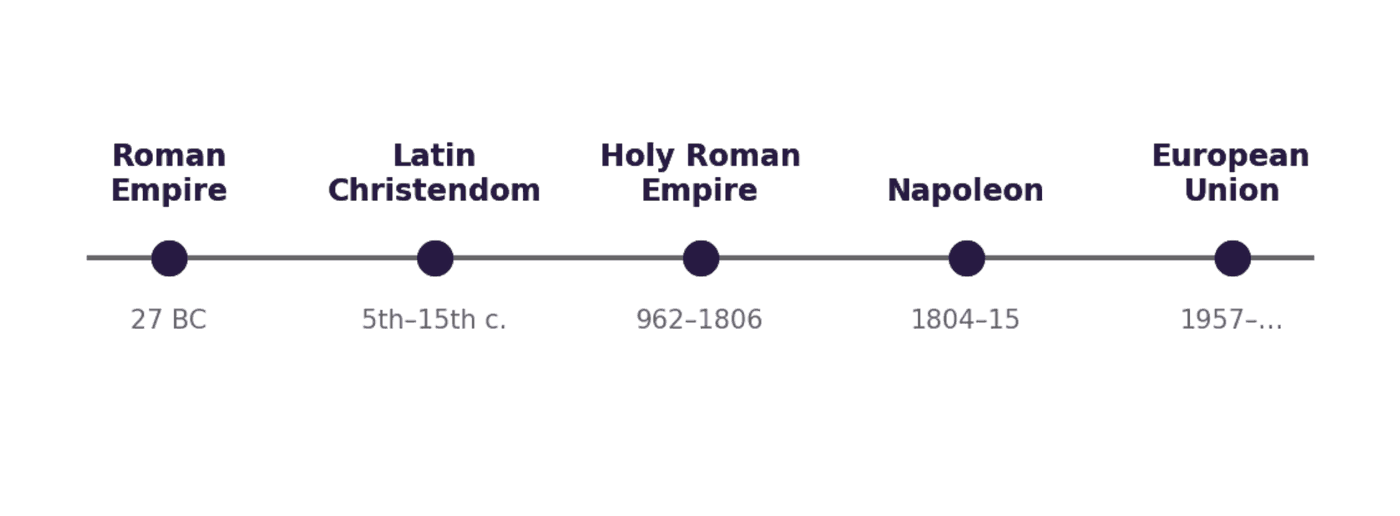
There is, at the base, the legacy of Rome: an empire that for half a millennium politically, legally, and administratively unified the entire continent around the Mediterranean, leaving a common learned language, Latin, and above all a body of law. There is Latin Christendom, the res publica christiana, which through the medieval millennium furnished Europe with a shared religion, a calendar, a network of universities, pilgrimages, and transnational monastic orders, and once again Latin as the lingua franca of learning. There are the great political constructions that held the heart of the continent together for centuries: the Carolingian Empire and then the Holy Roman Empire, within which individual territories we now call nations long coexisted under a common roof. There is the Napoleonic attempt at unification, which spread a homogeneous legal and administrative model from Madrid to Warsaw. There is, in the modern age, the Respublica literaria, the Republic of Letters: a genuinely pan-European intellectual community that corresponded, debated, and published across borders, first in Latin and then in French.
Onto this political-religious framework are layered phenomena that stitched Europe together from above and below at once. The artistic movements themselves—the Romanesque, the Gothic, the Renaissance, the Baroque, Neoclassicism—crossed borders like waves, giving Kraków and Seville, Palermo and Prague a recognizably common visual lexicon. The reigning dynasties intermarried to the point of making the European aristocracy a single continental kinship network, and with a single language, French. Students migrated from one university to another—Bologna, Paris, Oxford, Salamanca, Prague—within a single circuit of knowledge, with a single system of degrees and a single learned language, medieval Latin. Even the wars, paradoxically, were often European civil wars: people fought because they knew one another and contested the same inheritance, not because they were strangers.
Anyone who knows history is aware that a good many of today's individual European states have spent more time inside overlapping imperial or supranational entities than as fully sovereign nation-states—the latter being a phenomenon barely two centuries old. Fragmentation into jealous nations is not Europe's eternal and natural condition: it is a relatively recent parenthesis in its history.
The substrate: law, language, culture, political ideas
The second pillar is the substrate that history deposited, and which unites Europeans even when they do not realize it.
On the legal plane, most of continental Europe shares the tradition of Roman-derived civil law—the ius commune reworked by medieval and modern jurists—which produced codes and categories strikingly akin from Lisbon to Tallinn. On the linguistic plane, there is a core of Romance languages descended from the same Latin, and more broadly a deep kinship among the continent's great language families. On the cultural and ideological plane, Europeans are the common heirs of a patrimony no other space in the world possesses in the same combination: humanism, the Renaissance, the Reformation and Counter-Reformation, the Enlightenment, the experience of the free communes and the maritime republics, monarchy and the republican tradition, the scientific revolution and the industrial one, and finally the democratic constitutionalism of the post-war period, with its synthesis of individual and social rights. From this stock is born that model of civilization—more humanistic, more attentive to the person and their needs, including collective ones, less absolutely individualist—that distinguishes Europe even from other Western societies.
To this is added a trait Europeans recognize as their own the moment they cross the ocean: a peculiar social model. The idea that healthcare and education are rights, that labor is not blind servitude, that the state must correct the most glaring inequalities, is a political patrimony shared—with a thousand national variants—from Finland to Portugal, and perceived as specifically European precisely in contrast with other Western models. It is common political culture, no less than the monuments and the languages.
If we apply to this substrate Anthony Smith's grid—collective name, shared historical memories, elements of common culture, link to a territory, sense of solidarity—we find that Europe possesses, at continental scale, many of the traits of an ethnie. Not all, not with the same intensity as a nation; but enough to make ridiculous the idea that Europeans are as foreign to one another as they are to an inhabitant of another continent.
This element takes on a distinctive character. In a world moving toward globalization, in which the general counts ever more than the particular, does it make sense to look at the particulars that divide us or at the fundamentals that unite us? To put it more plainly: are we more occupied with marking our differences from a Spaniard or a Frenchman than with recognizing our similarities compared with a Russian or a Chinese person—does that make sense?
The proof of the present: data, generations, lived experience
The third pillar is the one that matters most, because it answers Renan on his own ground: the nation as present will, as a "daily plebiscite." This calls not for evocation but for numbers.
Europeans, when asked, declare themselves such by a clear majority. According to Eurobarometer surveys of 2025, 75% of the Union's citizens say they feel they are EU citizens, and 69% declare themselves "attached" to Europe.10 It is a figure that demolishes the image of Europeans indifferent to their own continental dimension. In the same period, 74% believe their country has benefited from EU membership—the highest percentage ever recorded.11 It is not yet full national consciousness; but it is exactly what one expects from a people in formation: a widespread and growing sense of belonging. A figure bound to rise, considering that the highest levels of Europeanism are recorded among the youngest age groups.
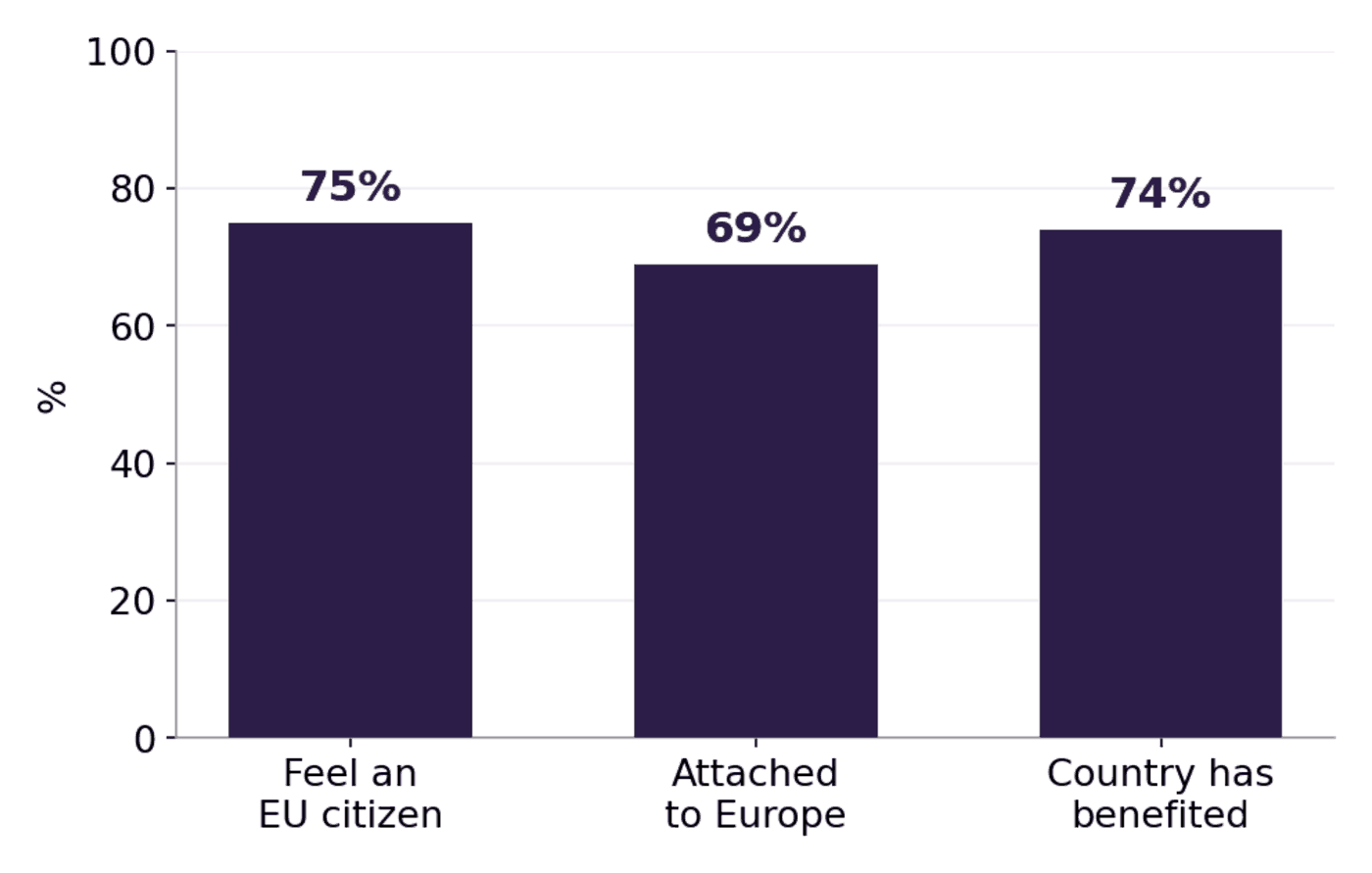
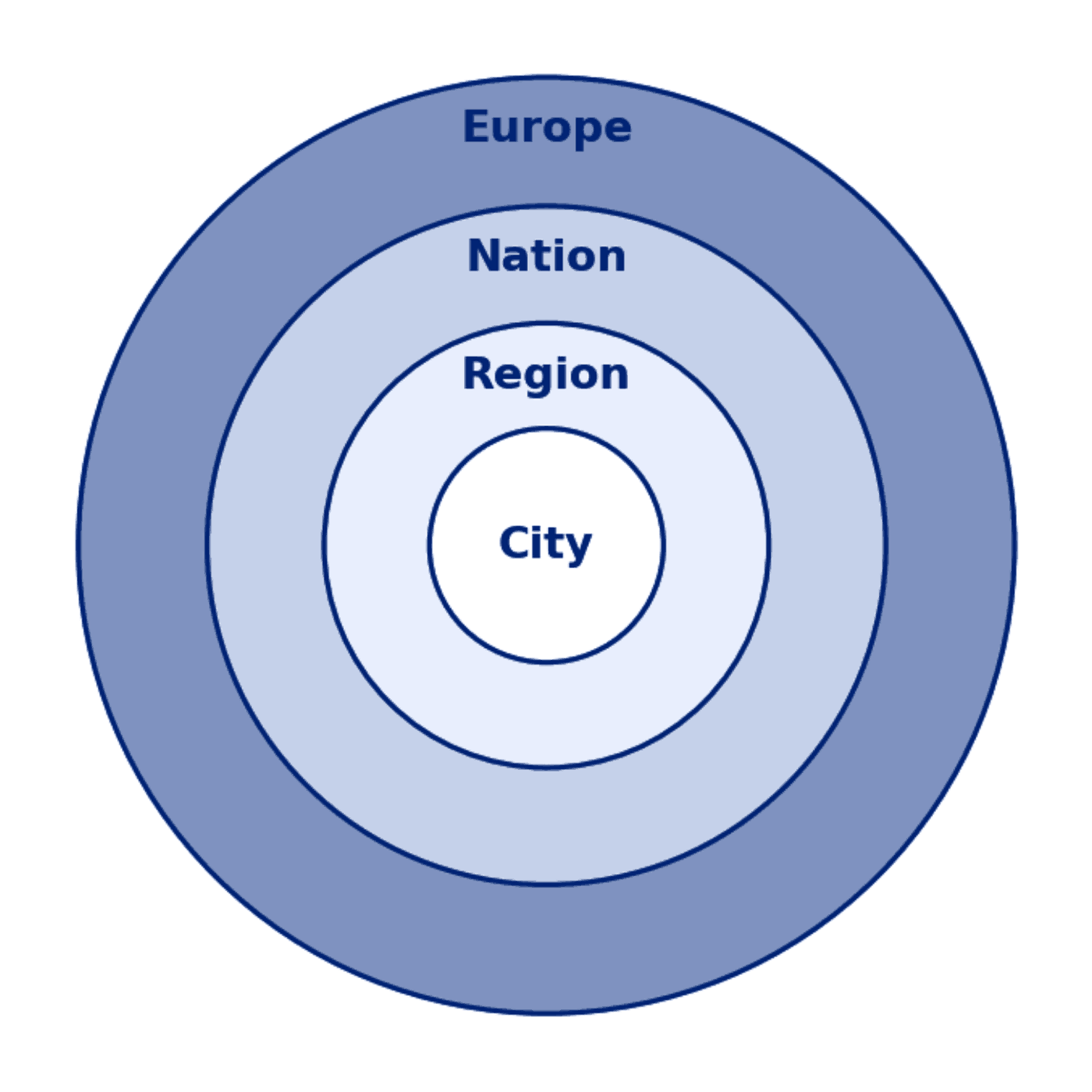
On closer look, these numbers tell not of substitution but of stratification: the majority of Europeans feel at once citizens of their own country and of the Union. European identity does not supplant the national one, it overlays it. Not by chance is this exactly how, historically, all broad identities have formed: not by erasing local belongings, but by incorporating them into a wider circle, as already happened to those who discovered themselves "Italian" without thereby ceasing to be Neapolitan or Piedmontese. A European people asks no one to renounce their nation, just as the nation did not ask the communes to renounce their bell tower.
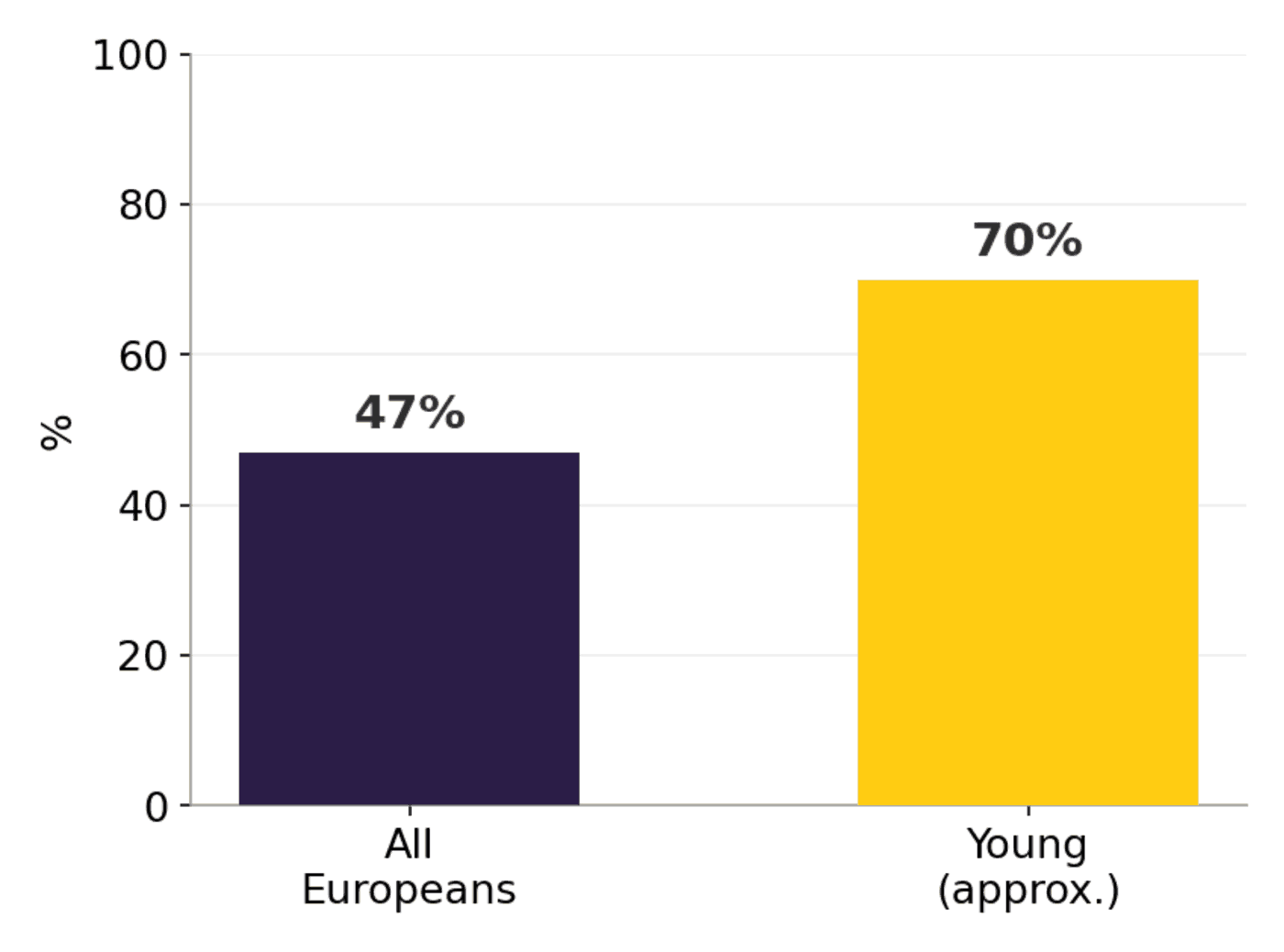
Then there is the seemingly decisive question of language. The classic objection—"without a common language there is no people"—is losing force before our eyes. English is by now the lingua franca of the continent: according to the 2024 Eurobarometer, it is spoken as a foreign language by 47% of Europeans, and by about 70% of the young.12 It is not everyone's mother tongue—neither was Latin, nor courtly French—but it performs the same historical function: to create the shared communicative space that Anderson considered the material precondition of the "imagined community." The precondition, in short, is materializing now. With it begins to form that European public sphere whose absence was, in 1995, the skeptics' strongest argument: today Europeans follow the same news cycles in real time—a summit in Brussels, an election in Paris or Berlin, an energy crisis, a war on the eastern borders, an ECB interest-rate decision—commenting on them on the same platforms and often in the same vehicular language. Clearly this is a community under construction, in an embryonic phase, fragmented and unequal; but it is the first time in history that such a continental communicative space exists outside the narrow elites of Latin and courtly French.
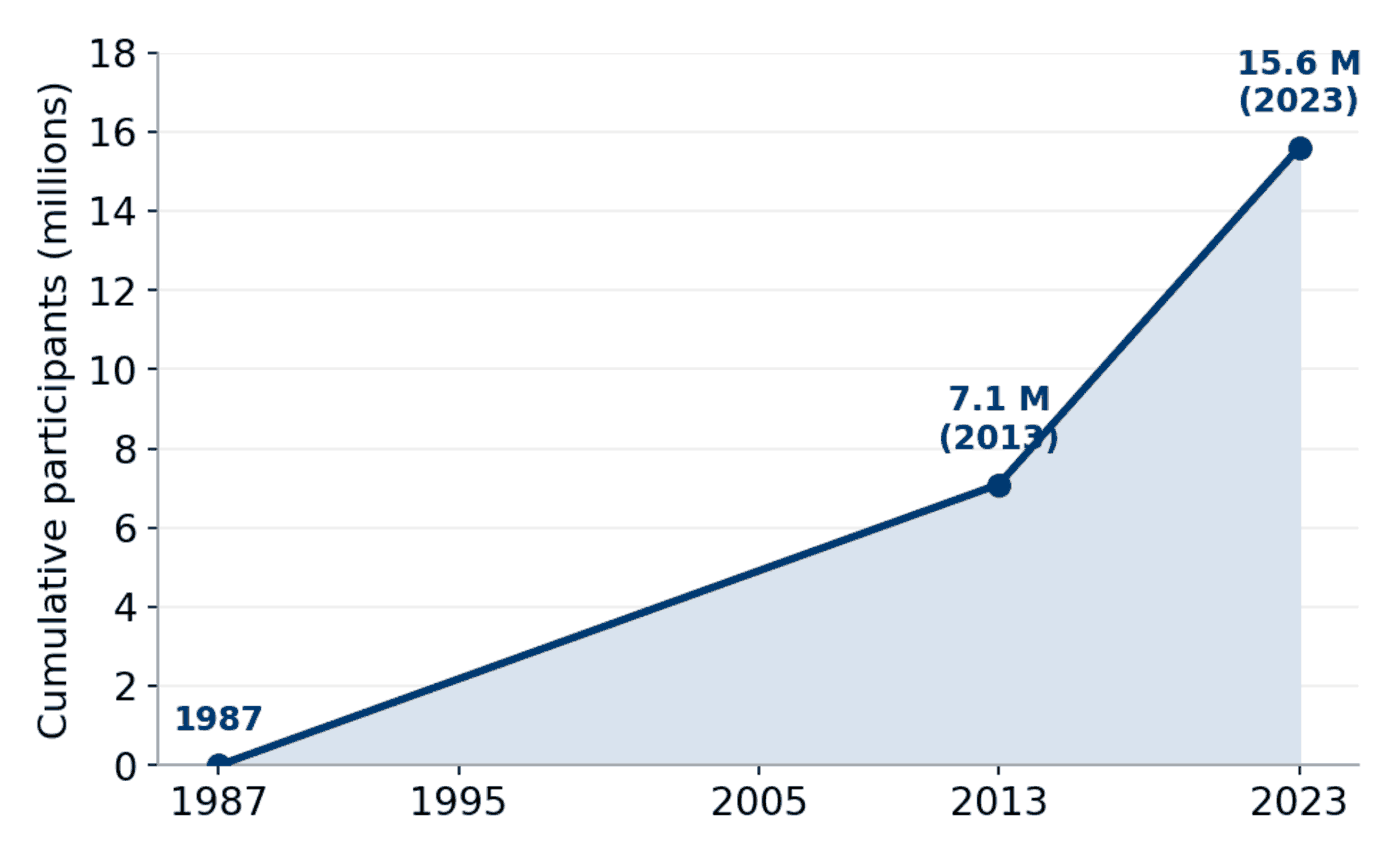
Finally, the lived experience of the new generations. The Erasmus programme has involved more than 15 million people since 1987, with an impressive acceleration: about 7.1 million up to 2013 and another 8.5 million in the single decade 2014-2023.13 An entire generation that has studied, worked, and formed emotional bonds across borders, that shares cultural consumption, digital platforms, references, and lifestyles from Lisbon to Helsinki. For these young people European identity is not an ideological abstraction: it is lived experience, biography. They are, literally, the first mass draft of a European people. Young Europeans today are strikingly alike: the same music, the same way of dressing, the same anglicisms, the same social platforms on which to express themselves, similar courses of study, perhaps in English, similar role models and aspirations.
Taken together—deep historical substrate, shared cultural-legal patrimony, rising indicators of belonging, an emerging lingua franca, generations with a transnational identity—these elements do not describe an absent people. They describe a people real but unfinished: what I have called a "blurred" people.
Objections and rebuttals
A serious thesis must withstand the best objections. I address four.
First objection: "The demos is missing. No common language, no European public sphere, no continental media or parties: without this, the European people does not exist" (Grimm, the Karlsruhe court). This is the strongest objection and must be honored. But it commits two errors. The first is chronological: it sets the bar at the endpoint of mature nations and applies it to a people in formation, as if one demanded of an adolescent the stature of an adult before granting them existence. The second is empirical: the public sphere and the common language that were missing in 1995 are forming now, driven by the English lingua franca and transnational digital media. Not by chance did Habermas reply that the demos can be built, not only found;14 and, as we shall see in Part II, no European nation had a "ready-made" demos before building one for itself: France fabricated it, literally, turning peasants into Frenchmen.15
Second objection: "National identities are alive and nationalisms are resurgent: proof that the European people does not take root." Here a false premise hides: that national and European identity are zero-sum, that one excludes the other. The data say the opposite: the vast majority of Europeans feel at once, say, Italian and European. Identities are nested, like concentric circles—city, region, nation, Europe—and coexist perfectly well, exactly as a Bavarian is German without ceasing to be Bavarian. The revival of nationalisms, if anything, is the defensive reaction to an integration perceived as already underway: one does not fight what does not exist.
Third objection: "Europeanism is lukewarm: low turnout in European elections, widespread euroscepticism." One must distinguish attachment to Europe from judgment on the institutions of the Union. The very surveys that record criticism of Brussels show attachment to Europe higher than to the EU itself: discontent strikes the institutional architecture, not continental belonging. It is a democratic and institutional deficit, not a deficit of people—a problem of the form of government, not of the existence of the community.
Fourth objection: "The 'imagined community' requires shared media that do not exist at European scale" (in an Andersonian key). It was true until yesterday. But Anderson's print capitalism now has its equivalent and indeed its amplification: digital platforms, social media, streaming, joined to the diffusion of English, are creating in real time the shared communicative space that the nineteenth-century nations took decades of newspapers to build. The factor Anderson deemed constitutive is not missing from Europe: it is bearing down on it now, at the speed of the network.
Conclusion of Part I
I return to the question. Does a European people already exist? My answer is: yes, however blurred and unfinished. It exists in its substrate—a civilization shared by history, law, language, culture, and political ideas, which stands up to Smith's ethnie grid. And it exists in its present—a sense of belonging declared by the majority, a lingua franca in rapid diffusion, a generation whose European identity is biography and not ideology, which satisfies Renan's criterion of will better than many imagine.
Whoever denies the existence of the European people does so by applying a definition—that of the ethnically and linguistically homogeneous nation-state—that is itself a historical myth, and that not even existing nations satisfied when they were born. If we accept, as science requires, that peoples are processes and not essences, then the European people is not a utopia to await: it is a reality in progress, to be recognized and cultivated.
Let us return, for a moment, to the vocabulary of the prelude. If by "European people" we mean a single ethnos, a common descent of blood, then no: it does not exist, and it is not even desirable that it should, because Europe's unity lies in its plurality. But if we mean a demos—a political community of citizens who share a civilization, a destiny, and the will to decide it together—then that people already exists in nascent form, and it is exactly the subject that a federal order should recognize and enable to govern itself. The question "does a European people exist?" has no clear-cut answer because it is badly posed: it depends on which people one is looking for. The ethnic people is a phantom no one is chasing; the political people is a reality that asks only to be taken seriously.
This is, however, a partial answer. For even granting that today the European people is only a sketch, two decisive questions remain: can it be built deliberately? And is it forming anyway, by force of circumstance? To the first is devoted Part II, where we will meet the France that "made Frenchmen." To the second, Part III, where we will see how the pressure of the great powers is welding Europeans together more than a thousand proclamations.
Coming soon, Part II—if this one hasn't already triggered you enough.
Tyler.
Notes
- A. D. Smith, The Ethnic Origins of Nations, Blackwell, 1986; Id., National Identity, 1991. The concept of ethnie: collective name, myth of common ancestry, shared historical memories, common culture, link to a territory, sense of solidarity. ↩
- E. Renan, Qu'est-ce qu'une nation?, lecture at the Sorbonne, 1882. The nation as a "daily plebiscite," founded on the common legacy of memories and the present will to live together; text: https://en.wikipedia.org/wiki/What_Is_a_Nation%3F ↩
- M. Weber, Economy and Society (posth., 1922), section on ethnic communities and the nation: the nation as a community of sentiment founded on the subjective belief in a common origin and destiny, tending toward a state of its own. ↩
- E. Gellner, Nations and Nationalism (1983). It is nationalism that produces nations, not the reverse: industrial society requires a standardized "high culture" diffused by mass schooling. ↩
- B. Anderson, Imagined Communities: Reflections on the Origin and Spread of Nationalism (1983). The nation as an "imagined" community, made possible by print capitalism; https://en.wikipedia.org/wiki/Imagined_Communities ↩
- E. J. Hobsbawm, T. Ranger (eds.), The Invention of Tradition (1983). Many "national traditions" are recent constructions. ↩
- D. Grimm, "Does Europe Need a Constitution?", European Law Journal, 1(3), 1995, pp. 282-302. The no demos thesis: https://onlinelibrary.wiley.com/doi/abs/10.1111/j.1468-0386.1995.tb00033.x ↩
- BVerfG, Maastricht Treaty ruling (1993) and Lisbon Treaty ruling (2009): democratic legitimacy anchored to the Staatsvolk, absent at the European level. See also J. H. H. Weiler, "Does Europe Need a Constitution? Demos, Telos and the German Maastricht Decision", European Law Journal, 1(3), 1995. ↩
- J. Habermas, "Remarks on Dieter Grimm's 'Does Europe Need a Constitution?'", European Law Journal, 1(3), 1995; and Id., The Crisis of the European Union: A Response (2011). Constitutional patriotism: European political identity as a construction around shared civic principles and an emerging public sphere. ↩
- European Parliament / European Commission, Eurobarometer 2025 (winter survey, January-February 2025; Standard Eurobarometer 103, spring 2025): 75% feel they are EU citizens; 69% declare themselves attached to Europe. https://www.europarl.europa.eu/news/en/press-room/20250317IPR27385/survey-confirms-europe-s-citizens-want-the-eu-to-protect-them-and-act-in-unity ↩
- Ibid.: 74% of citizens believe their country has benefited from EU membership, the highest value ever recorded for this question. ↩
- European Commission, Europeans and their languages, Special Eurobarometer, May 2024: English is spoken as a foreign language by 47% of Europeans; about 7 in 10 young people can hold a conversation in English. https://ec.europa.eu/commission/presscorner/detail/en/ip_24_2686 ↩
- European Commission, Erasmus+ — History, funding and future: over 15 million participants since 1987 (about 7.1 million up to 2013; a further 8.5 million in 2014-2023). https://erasmus-plus.ec.europa.eu/about-erasmus/history-funding-and-future ↩
- J. Habermas, "Remarks on Dieter Grimm's 'Does Europe Need a Constitution?'", European Law Journal, 1(3), 1995; and Id., The Crisis of the European Union: A Response (2011): the demos as the outcome of a process of political construction, not as a given ethnic premise. ↩
- E. Weber, Peasants into Frenchmen: The Modernization of Rural France, 1870-1914, Stanford University Press, 1976. The deliberate construction of French national identity; a central theme of Part II. (Not to be confused with Max Weber, cf. note 3.) ↩
Select bibliography
- Anderson, Benedict, Imagined Communities: Reflections on the Origin and Spread of Nationalism, 1983.
- Gellner, Ernest, Nations and Nationalism, 1983.
- Grimm, Dieter, "Does Europe Need a Constitution?", European Law Journal, 1995. https://onlinelibrary.wiley.com/doi/abs/10.1111/j.1468-0386.1995.tb00033.x
- Habermas, Jürgen, "Remarks on Dieter Grimm's 'Does Europe Need a Constitution?'", European Law Journal, 1995; The Crisis of the European Union: A Response, 2011.
- Hobsbawm, Eric J. and Ranger, Terence (eds.), The Invention of Tradition, 1983.
- Renan, Ernest, Qu'est-ce qu'une nation?, 1882. https://en.wikipedia.org/wiki/What_Is_a_Nation%3F
- Smith, Anthony D., The Ethnic Origins of Nations, 1986; National Identity, 1991.
- Weber, Eugen, Peasants into Frenchmen, 1976.
- Weber, Max, Economy and Society, 1922.
- Weiler, Joseph H. H., "Demos, Telos and the German Maastricht Decision", European Law Journal, 1995.
- European Commission, Europeans and their languages, Eurobarometer, 2024. https://ec.europa.eu/commission/presscorner/detail/en/ip_24_2686
- European Parliament, Eurobarometer 2025. https://www.europarl.europa.eu/news/en/press-room/20250317IPR27385/survey-confirms-europe-s-citizens-want-the-eu-to-protect-them-and-act-in-unity
- European Commission, Erasmus+ — History, funding and future. https://erasmus-plus.ec.europa.eu/about-erasmus/history-funding-and-future